How broadcasters are using digital platforms in the Senedd election campaign

Voters in Wales go to the polls this week to elect members of a newly expanded Senedd, marking an important moment in the evolution of devolved politics. To understand how this election has been reported and new voting system has been explained to audiences, our research has tracked coverage across both UK-wide and Wales-specific broadcasters, including flagship TV news bulletins on the BBC, ITV and Channel 4, alongside online news articles from BBC Wales, ITV Wales, S4C and Sky News, and social media content produced by these outlets.
This blog focuses specifically on broadcasters’ digital content produced during the campaign so far, reflecting broader shifts in how audiences access political information. Research by the Electoral Commission shows that young people, in particular, are more likely to encounter political content via social media than through formal education settings, such as schools or colleges. As a result, digital platforms are playing an increasingly central role in how political information is distributed, encountered and understood.
However, the way political content is consumed online differs markedly from traditional news such as television and print. Rather than actively seeking out information, audiences often encounter political content passively through algorithmically curated feeds and suggested posts. This means that digital content plays a role in shaping public understanding of the election. Our analysis examines how broadcasters are engaging with increasingly digital audiences and what kinds of information voters are most likely to encounter in the lead-up to polling day.
Overview
Welsh broadcasters are pursuing a deliberate digital strategy in their coverage of the Senedd election, combining public service values with social media logics to connect with younger voters who are more likely to get their political information online.
Welsh broadcasters are combining two distinct but complementary digital formats—explainers and one-to-one interviews—to both inform audiences about the election and introduce the leaders of the six main political parties.
Explainers are playing an important role in addressing gaps in public understanding, particularly given ongoing confusion about whether policy responsibility lies with the Senedd or Westminster.
One-to-one interviews have been used extensively and increased the visibility and potentially the recognisability of Welsh political leaders, addressing relatively low levels of public awareness compared with UK-level figures.
Explaining the election
Explainers are playing a key role in demystifying the Senedd election, outlining how the system works, how it has changed, and which powers sit with Wales or Westminster. This content often adopts a more informal and accessible tone than traditional broadcast coverage, which is particularly important online where political information must compete for attention in fast-moving environments and is often encountered while scrolling, rather than actively sought out.
Across the study period so far, we identified 19 explainers across the five broadcasters. The BBC produced the highest number with explainers making up 37% of its election coverage in our sample. ITV’s explainers accounted for 13% of its coverage followed by S4C at 10% and Sky News at 3%. Channel 4 have not produced any explainers in the period examined.
The majority of explainers shared across the study period focused on policy with seven of the 19 explainers related to immigration and four on independence. This focus is important given our representative survey of the Welsh public in February 2026 identified many people were confused about which issues are controlled by the Senedd and which remain the responsibility of Westminster.
Other explainers have focused on the election process itself. These included items on key campaign dates, changes to the Senedd and voting system, and what happens after votes are counted. This matters in the context of the 2026 election, which will be the first where the Senedd expanded from 60 to 96 members.
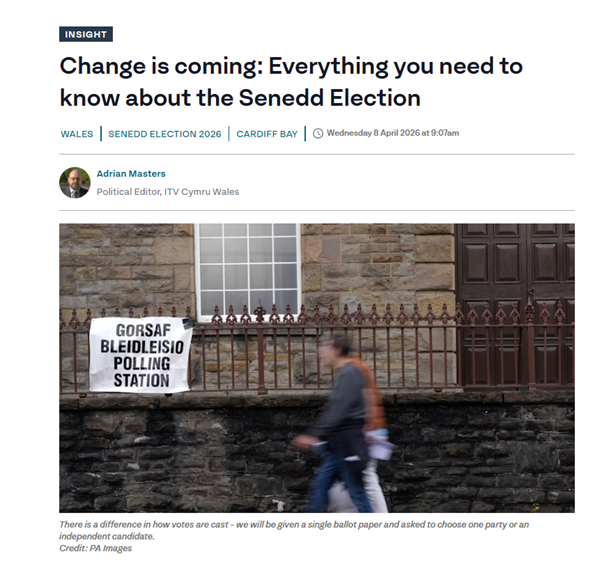
Broadcasters also used creative ways to explain the new voting system, including the use of cake. With this year’s election set to introduce a closed-list proportional system such explainers are particularly important. Our survey found only 7% of respondents correctly identified the new voting system while 58% said they did not know.
Other explainers focused on practical aspects of participation, including how to register to vote and key deadlines for doing so, providing audiences with the information needed to take part in the election rather than simply understand it. Less frequently, broadcasters also produced explainers outlining what the Senedd does or supplied information about which candidates were standing in each constituency.
Taken together, the use of explainers show broadcasters were using online platforms to not only report the campaign but to address gaps in public understanding of Welsh democracy.
One-to-one interviews
Alongside explainers, broadcasters have also used digital formats to introduce audiences to the leaders of Wales’s six main political parties. This is important as parties are increasingly defined by their leaders although, in a devolved context, this can be complicated by the presence of both UK-wide and Welsh leadership figures.
Across the study period so far, we identified 16 one-to-one interviews, the majority of which were produced by the BBC and ITV, with 10 and 6 items respectively. Overall, this format accounted for 33% of the BBC’s election coverage and 20% of ITV’s reporting.
These interviews injected personality into political coverage. In formats such as the BBC’s “Quickfire Questions” and ITV’s “Chippy Chats”, broadcasters moved between light-touch prompts (“What song have you got on repeat?”) and political questions (“What policy idea are you most excited about?”), presenting leaders not only as party representatives but also as individuals.
ITV’s “Chippy Chats”, in particular, offered an informal style of political interview, combining policy discussion with personal anecdotes. Such formats are important in light of our survey, which found relatively low public awareness of Welsh party leaders compared with UK-level figures. For example, only 62% of respondents recognised Eluned Morgan (Labour), 47% recognised Rhun ap Iorwerth (Plaid Cymru), 10% recognised Dan Thomas (Reform UK) and just 4% recognised Anthony Slaughter (Green).
These one-to-one interviews appear to serve a dual purpose, helping audiences understand what party leaders stand for politically while also increasing their visibility and recognisability in a campaign where public knowledge of Welsh political leadership remains uneven.
Conclusion
Taken together, these findings suggest that broadcasters have used digital platforms in distinct and complementary ways so far in the Senedd election campaign.
Explainers have been used to clarify how the political system works and to address gaps in public understanding while one-to-one interviews are helping to make party leaders more visible and relatable to audiences. This strategy reflects a broader shift in how election coverage is produced and consumed. As more people encounter political information online, the form and framing of that content becomes increasingly important.
As Wales approaches polling day, the challenge for broadcasters will be to balance these different forms of digital content: ensuring that efforts to inform and engage audiences are matched by clear, consistent and rigorous scrutiny. This is becoming more important as voters increasingly rely on online news and social media to make sense of complex political issues and to inform their decisions at the ballot box.