After winning the by-election, should the Greens be given more airtime?
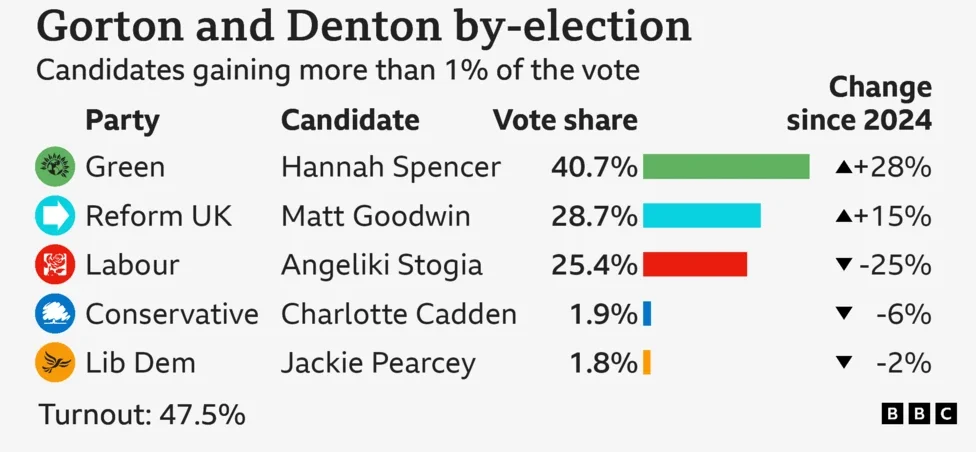
News programmes are leading their coverage this morning with the Greens’ historic victory in the Gorton and Denton parliamentary by-election – the first the party has ever achieved. But our new research at Cardiff University reveals the Greens have received limited airtime over the last year despite almost doubling their support in the polls and in party membership. While Reform UK has seen a spike in media coverage since it took a commanding lead in the polls, our research shows the Greens have not received more airtime in recognition of their growing popularity.
Gorton and Denton was Zach Polanski’s first electoral test as leader of the Green Party of England and Wales, and it delivered a striking result. Widely framed as a three-way contest between the Greens, Labour and Reform – the Green candidate Hannah Spencer secured a decisive 12-point victory over Reform, winning 40.7% of the vote.
The result significantly exceeded polling expectations and marked a sharp improvement on the party’s 13.2% vote share in the constituency at the 2024 general election. While by-elections are notoriously volatile and imperfect indicators of national mood, the scale of the Greens’ win brings into sharper focus the question of how the broadcasters treat the party in news and current affairs programming.
Despite today’s electoral success and sustained improvements in opinion poll ratings, our new research suggests broadcasters still treat the Greens as a minor party of little electoral significance.
As part of our AHRC Enhancing Impartiality project, we have been tracking coverage of UK opposition parties on BBC News at Ten and ITV News at Ten, the UK’s most-watched nightly TV news bulletins.
In 2025, the Greens were the 6th most covered opposition party, being referenced in just 32 items, behind the Conservatives (375), Reform UK (213), the Liberal Democrats (116), the SNP (46), and ahead of Plaid Cymru (10).
As part of our analysis, we tracked how often a party was the leading focus of a broadcaster’s report. The Greens led four items. Three on BBC and one on ITV. These stories related to the Greens’ May local election campaign, Zach Polanski winning the party leadership in September and the party conference in October.
Neither BBC News at Ten nor ITV News at Ten covered the announcement or build-up to the leadership contest.
In contrast, Reform UK led 69 items, the Conservatives led 45 items, the Liberal Democrats led 14 items, and the SNP led 13 items.
The Greens also appeared on only four episodes of BBC Question Time during 2025. That was about a third as often as the Liberal Democrats and Reform UK.
Despite the leadership change, the subsequent surge in membership, and the sustained rise in poll ratings from 11% in August 2025 to 17% in December 2025, broadcast coverage of the party did not increase during the remainder of 2025.
This seems to demonstrate a potential inequality of treatment between the rising parties of left and right. The BBC cited improvements in opinion polling as one of the factors behind the increased coverage of Reform UK, but the Green party’s popularity has not received anywhere near the same recognition. Our analysis shows that despite a bump in support for the Greens from September 2025, TV news coverage of the party has broadly declined rather than increased.
In May 2025, Reform UK saw a substantial increase in news coverage following its victories in local and mayoral elections, with broadcasters taking this as a sign that the party was now a major factor in UK electoral politics. Our research even showed in September 2025 Reform UK was referenced on TV news more than the Conservatives, the party that is supposed to be the UK’s Parliamentary official opposition.
The question now is whether broadcasters will take the Green Party’s victory in Gorton and Denton as a similar sign of its electoral significance and increase coverage over the coming months.
As part of the Enhancing Impartiality project, our researchers at Cardiff University will be continuing to monitor and track political party coverage, with a focus on the upcoming elections in Scotland and Wales.